Most businesses treat free Wi-Fi as a fixed operating cost. The access point gets installed, the bandwidth gets consumed, and the measurable return is that visitors don’t complain about connectivity. There’s nothing wrong with that approach, but it leaves a revenue opportunity sitting unused.
Offering free Wi-Fi to visitors doesn’t prevent an operator from earning money from the same infrastructure. Every person who connects passes through a captive portal before reaching the internet. That login screen is an advertising placement. Businesses across retail, hospitality, and public infrastructure are using it to generate income from sponsored campaigns, promote their own services, or both.
How captive portal advertising works
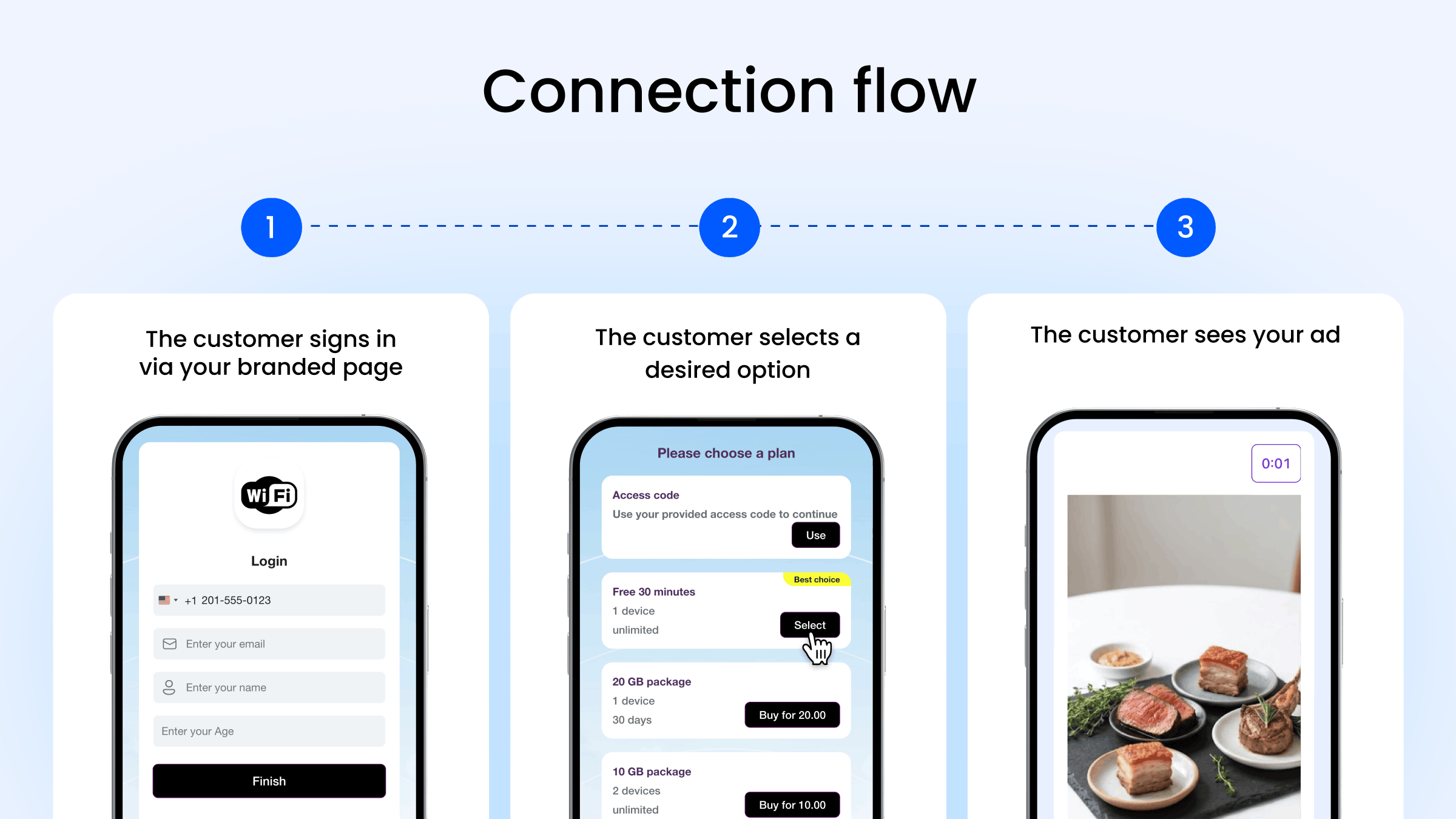
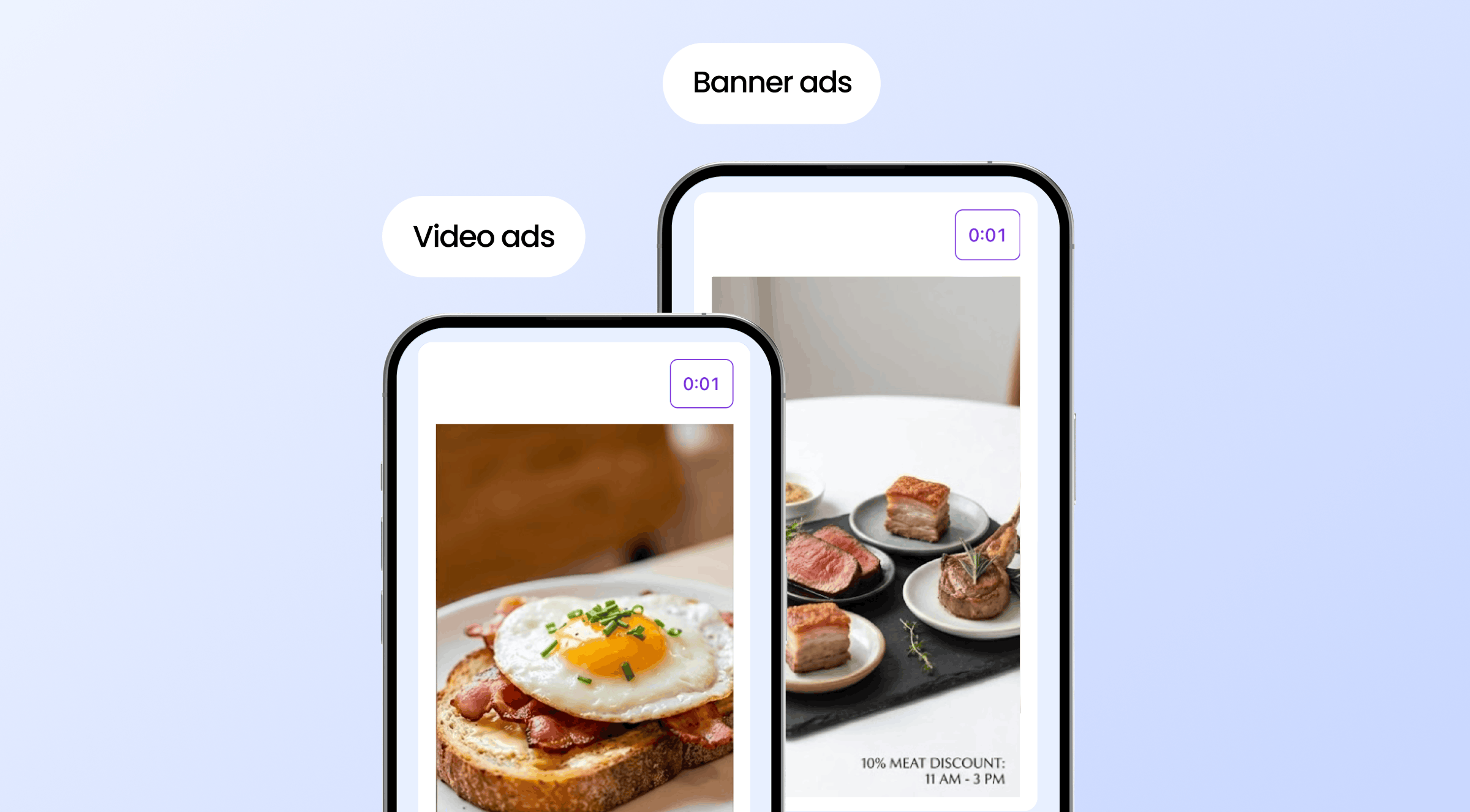
When a visitor joins a free Wi-Fi network, the device is redirected to a captive portal before reaching the internet. The visitor provides a contact detail, accepts the terms, and chooses a plan. Then, before getting online, a full-screen advertisement appears. For image ads, it plays for a configured duration. For video, it runs to completion. There is no skip option. Once it finishes, internet access is granted and the impression is recorded.
The placement has a quality that most digital advertising lacks. The person is physically on-site, momentarily stationary, and the screen shows nothing else. They are not scrolling past a banner ad or tabbing away from a pre-roll video. The ad occupies the full screen for a defined period, and there is no way around it.
An operator can use the placement to show their own promotions, sell it to external advertisers, or combine both. The visitor still gets free internet access. Revenue comes from whoever is paying for the advertising space.
How different businesses are using it
Shopping malls and retail centers
A shopping mall provides free Wi-Fi to visitors across its floor space. Tenants inside the mall have an obvious interest in reaching those visitors at the right moment. A clothing retailer might promote a weekend sale. A restaurant might advertise a lunch special during the late morning. A cinema could promote evening screenings from mid-afternoon onward.
The mall operator sells advertising placements to participating tenants on a campaign basis, reporting impression counts that show how many visitors saw each ad. Different promotions can be scheduled for different times of the day, which allows multiple tenants to share the same inventory without running at the same time.
In this arrangement, the mall continues offering free Wi-Fi to visitors while generating additional revenue from the tenants who benefit from the foot traffic it attracts. The Wi-Fi access point becomes part of the commercial relationship between the mall and its tenants, rather than a cost sitting outside it.
Read MeshTelecom case study to explore how they monetize and manage their mall Wi-Fi.
ISPs and public hotspot operators
An ISP managing Wi-Fi hotspots across a city or region operates something more useful than a single advertising location: a network. A local business that wants to reach consumers across a trading area can buy advertising across a defined set of hotspots rather than just one. The ISP reports impression data per location, which gives the advertiser a view of where their campaign landed.
Powerlynx lets operators assign campaigns to specific locations and run them across multiple sites simultaneously. A regional campaign might run across all city-center hotspots. A more targeted one might cover the commercial district closest to a particular retailer. Either way, the operator sells reach within a defined area.
ISPs that already sell vouchers for paid Wi-Fi access can add advertising inventory as a second revenue layer on the same infrastructure. The advertising supplements rather than replaces the access fee income. Inovi Tel, an ISP operating 57 Powerlynx-powered hotspots across Limpopo, South Africa, runs both models in parallel: voucher revenue as the primary income stream and targeted advertising campaigns for local businesses as a second layer.
Hotels and hospitality
Hotels have two distinct uses for captive portal advertising. The first is internal promotion. A guest connecting to hotel Wi-Fi at check-in is on the property, has time, and hasn’t yet decided how to spend their stay. A spa offer, a restaurant promotion, or a local experience arrangement shown at that moment reaches someone in a position to act on it. The same placement can carry early check-out reminders, in-house event announcements, or anything else the hotel wants guests to see on arrival.
The second use involves third-party partners. A local tour operator, a nearby restaurant, or an airport transfer service can pay to reach arriving guests specifically. That’s a more targeted audience than most advertising channels in the area can offer: people who have just arrived, are unfamiliar with their surroundings, and are actively looking for things to do and places to visit.
Both approaches use the same placement. The distinction is who pays for it. Promoting the hotel’s own services is a marketing expense. Selling space to external partners is advertising revenue.
Restaurants and cafes
A guest connecting to a restaurant’s Wi-Fi is already a customer, already in the venue, and typically waiting for something. A limited-time offer, a new menu item, or a loyalty program shown during the connection moment reaches someone who can act on it immediately without leaving the building. The context is difficult to replicate in any other advertising channel.
For multi-site operators, a campaign set up in Powerlynx runs simultaneously across all configured locations without separate setup at each site. A chain with 30 locations reaches guests across the full network from a single campaign. Seasonal promotions, product launches, and staff events can be communicated this way without relying on in-venue signage or social media reach.
Where a venue is well-placed to attract a recurring audience, neighboring businesses sometimes pay for advertising access to that audience. A gym near a popular brunch spot, a delivery service in a high-footfall cafe area, or a local retailer wanting to reach lunchtime visitors are the kinds of arrangements that can develop from the right location.
Event venues
A conference brings a defined audience together in one place for a set period. The people connecting to venue Wi-Fi on the opening morning have self-selected by attending; they share an interest in the topic and are more concentrated than almost any digital audience a sponsor can buy. That makes the captive portal placement during an event genuinely valuable to the right advertiser.
Event sponsors, exhibitors, and commercial partners can pay for advertising visibility tied to the event dates. A software company sponsoring a technology conference might want every attendee connecting to Wi-Fi on day one to see their campaign. A retailer exhibiting at a trade show might run a promotion specifically during the exhibition floor hours. Campaign date ranges and time-based scheduling in Powerlynx let venues offer sponsors very specific packages, tied to particular sessions, days, or event segments.
For recurring events, advertising inventory can be sold as part of the sponsorship tier for each edition, giving sponsors a predictable presence and venues a structured additional revenue stream from infrastructure they already operate.
Reaching the right audience
The basic version of Wi-Fi advertising is a full-screen ad shown to everyone who connects at a given location. That’s already a useful placement. But the more targeted the ad, the more value it can carry for an advertiser, and the more an operator can reasonably charge for it.
Powerlynx supports campaign targeting by location, by the data plan a user selects, and by audience segment. A campaign restricted to users who chose the free-access plan, for example, doesn’t interrupt visitors who have paid for a premium tier. A campaign restricted to a specific splash page runs only at particular venues in a network.
Audience segments, called Target Groups in Powerlynx, are built from filters applied to the data an operator collects at sign-up. If a splash page gathers age or gender, the operator can create a segment based on those values and attach it to a campaign. Only users who match the filters see the ad. New users who meet the criteria are added to the segment automatically as they connect.
Time-based scheduling lets multiple creatives run within a single campaign, each covering a different part of the day. A breakfast promotion runs in the morning, a lunch deal takes over at midday, and a different creative covers the evening. The operator manages one campaign rather than several, and different advertisers or offers can occupy different time windows without competing.
Operators can also reach connected users after a session ends, through Mass SMS and Mass Email. Both can be sent to selected segments immediately or scheduled for a later date. Using either for marketing purposes requires valid consent from users at sign-up, which operators need to address in their splash page terms and conditions.
Campaign performance is tracked through impression counts, visible per campaign. A view cap can be set so a campaign stops automatically once it reaches the limit. That makes it practical to sell fixed-impression packages to advertisers, with the delivery confirmed by the platform rather than reported manually.
Powerlynx includes Wi-Fi advertising functionality as part of its hotspot management platform. Operators can explore the full feature set, including advertising, target groups, and post-session communication, during a 21-day free trial. More information is available at powerlynx.app/wifi-advertising, and the advertising documentation is at docs.powerlynx.app/system/adverts.html.